On Wednesday, September 20th, I hobbled my way into Buffalo Public School 192, the Academy for Visual and Performing Arts as I continued to recover from my foot surgery a month prior. While walking around outside of my apartment can be exhaustive in my cam walker, I was on a mission. I had made plans to attend the Board of Education meeting that night, along with a group of parents all focused on one thing—advocacy on behalf of their young children with disabilities. As a reminder, the Buffalo Public Schools had eliminated their 6:1:1 classrooms in their autism program and moved all of those children to 8:1:1 classrooms without parental approval. This was what they wanted to speak about.
If you’d like to WATCH the meeting, you can click here. All BPS Board of Education meetings are livestreamed and recorded on YouTube.
I hadn’t registered to speak (how interesting to register during a democratic forum), so my plan was to take qualitative field notes and then analyze them at a later time for not only this blog post, but for the families to reflect on. When I sat down in the auditorium, I began chatting with a mother that I personally knew on a professional level, as I had been the SEIT for her son a couple of years ago. I was quickly introduced to another mother who I had previously been told was the “powerhouse” of the group. She said she had been in the academia field at some point, so I decided to talk shop.
“I’m here taking some QUAL notes,” I explained. “If they open up the floor, I may say something.”
“Oh, they won’t, they never do.” this mother quickly said back to me.
Before I go into the gritty details of the meeting, I want to clearly express my bias in taking these qualitative field notes and my reporting. Every researcher does their best to remain as unbiased as possible during a study, but there is always some level of bias that should be responsibly stated. Besides the fact that I am extremely concerned about the disruption of rights and services for children with disabilities, specifically autism, all of which incapsulates my background, I knew one of the mothers in the advocacy group very well as I said before. In fact, it would turn out that I knew another mother in the group, so I would also like to say that here. I knew them, I knew their children, and I was upset for all of them.
These were my questions I wanted to focus on:
- How do the superintendent and board view the concerned parents of special education students?
- How does the superintendent react to audience member statements?
- How does the board react to audience member statements?
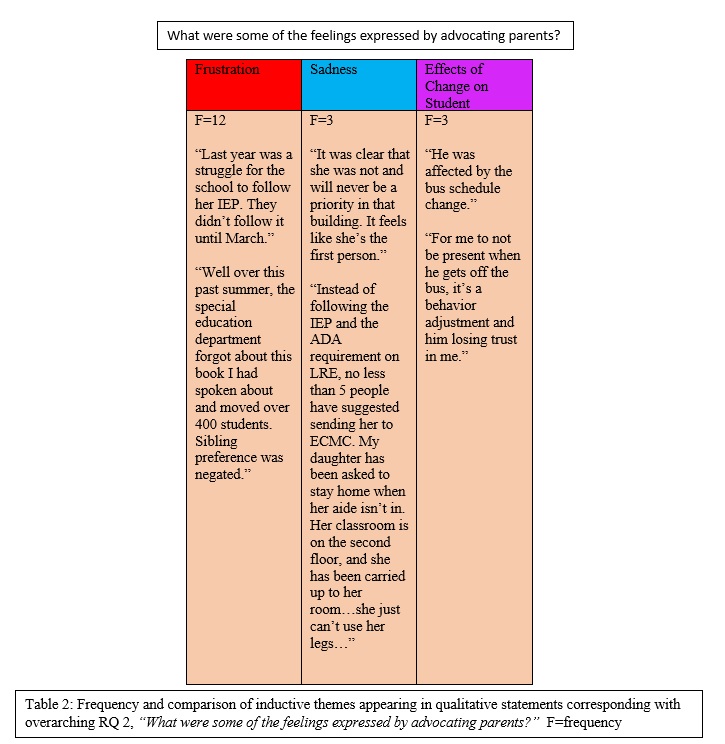
- What were some of the feelings expressed by advocating parents?
I followed an inductive analysis using a bit of grounded theory to go over my notes, statements and comments to generate some basic findings and reoccurring themes/patterns. The following themes were identified and coded in my transcript:
- Frustration
- Sadness
- Change of Topic
- Avoidance
- Personal Involvement
- Effects of Change on Student
During my peripheral observation, multiple parents displayed frustration and sadness for different things. Two parents were concerned about transparency, where procedural changes weren’t made apparent, such as bussing changes and changes to forms. Another parent was very concerned about lack of notifications, and stated that it was a pattern that the school district doesn’t notify the parents on many things. In fact, she went on to say that she was never notified about who her son’s new CSE chair was, and that it took three weeks to find out. One older man was concerned about school performance and the state of the schools. Lastly, one parent was concerned that her voice wasn’t heard at a previous meeting concerning students with autism (this woman proposed a resolution to assist with the special education problems), while another cried about egregious violations to her child’s special education rights.
When the speaker section closed and the superintendent opened up her own comments, it became apparent of the preference of what the superintendent, Dr. Williams, wanted to comment on. She generally avoided almost anything directly related to the special education concerns. She almost entirely spoke about the transportation problems. Anything that had to do with special education was set up with avoidance, by putting the problem on other district member’s plates (“I’m going to reach out to [district member] with your concerns”), or with statements such as, “Sometimes it can feel that for some parents their voices aren’t heard, but there are so many ways to get that voice heard…I meet with parent groups every month.”
A statement like this almost sounds like the guilt is being placed on the parents, as if they don’t participate in these groups and committees. However, it is very clear that these parents in particular are involved, where some are in Operation Sunrise (a transportation committee) or a parental special education group for the district. And if Dr. Williams really was meeting with these groups and committees every month, why was there absolutely no communication about the elimination of a 6:1:1 classroom setting, or transportation, or any other problems?
I’m glad that once Dr. Williams was done speaking that the majority of the board tackled the special education class issue, such as Dr. Ann Rivera and Jennifer Macozzi. The following is an excerpt from Dr. Rivera:
“I want to make it clear that this board needs to work on this. We must have a full range of classrooms. We have children who need consistency. We cannot move them and expect them not to struggle academically, exhibit behaviors, regression is real. When you disrupt their foundation, everything flows out of that, all the things that happen on the bus, in the hallway, all the things that happen every day.”
It appears to me that while Dr. Williams says that she cares and has a heart for the special education community, she blatantly refuses to acknowledge the pain that the classroom situation has caused them. She appeared to be more invested in those high school students that completed the Trocaire partnership program (you can watch this part in the YouTube video), which had put Buffalo Public Schools in a positive light. I understand that she is trying to save the district from the destruction that the previous superintendent caused it, but this isn’t the way to do it. If Dr. Williams truly listened to the statements of these parents, then she would have acknowledged their pain and acknowledged the trouble that this elimination of classrooms caused these students—all of which was under her supervision.

 Samantha Didrichsen, MSED.